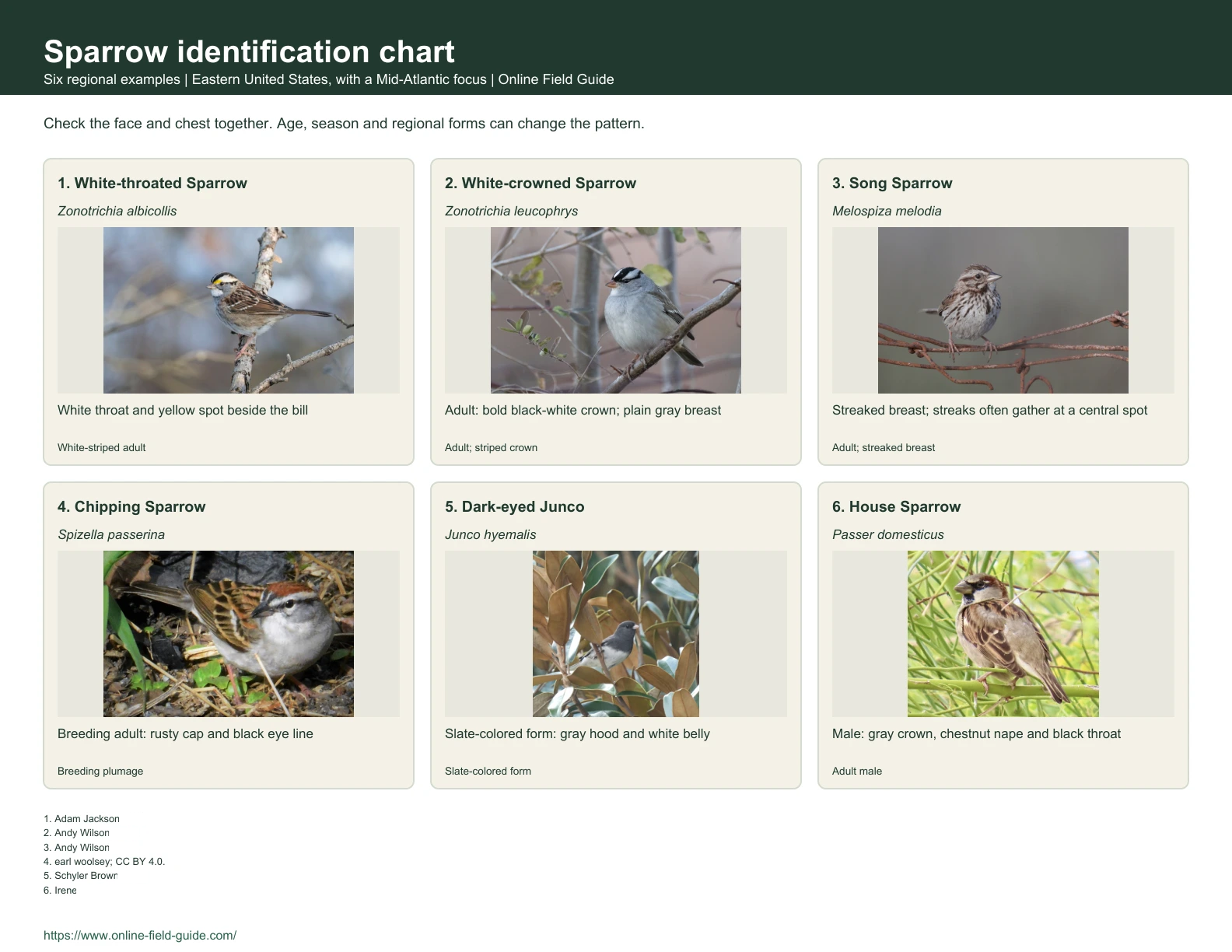
Identify a small brown backyard bird by checking the chest, crown, eye line and bill before counting stripes. A white throat with yellow beside the bill suggests a white-throated sparrow. A streaked chest with a central spot suggests a song sparrow, but lookalikes need a closer view.
These six birds occur in the eastern United States, with a Mid-Atlantic backyard and woodland-edge focus. Dark-eyed juncos belong to the New World sparrow family; house sparrows belong to a different family but are included because people often compare them. This is not a complete key to every small brown bird.
Select the chart to open a larger view. Original photo sources, creators and licenses appear in the cards below and in the printable PDF.
Sparrow identification at a glance
Seasonal occurrence is for the Mid-Atlantic, not every eastern county. The illustrated adult plumages may differ from juveniles and nonbreeding birds. On a small screen, scroll the table sideways.
Eastern United States, with a Mid-Atlantic focus sparrow comparison: appearance, habitat and season
Open a photograph for a larger view. Read the photo label before comparing the markings.
White-striped adult
Species candidate
1. White-throated Sparrow
Zonotrichia albicollis
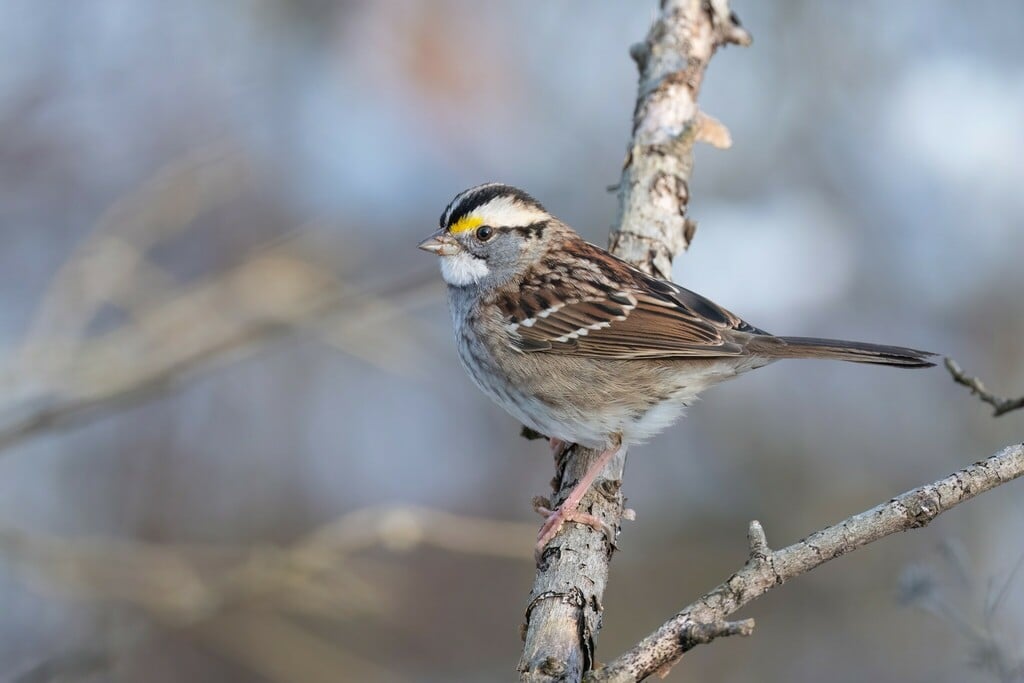
White throat contrasts with a gray breast
Yellow lores between the eye and bill
Look beneath the bill for the white throat, then beside the bill for yellow. The chest is gray rather than strongly striped. Crown stripes can be bright white or tan because two normal color forms occur. A tan-striped bird is not simply a young version of a white-striped one. Both forms need the same throat-and-face comparison.
Lookalikes: White-crowned sparrows lack the conspicuous yellow lores and sharply defined white throat. Some young birds require a less obvious face-pattern comparison.
Where to look: Brush, woodland edges and sheltered gardens. Seasonal occurrence: Fall through spring; breeds farther north.
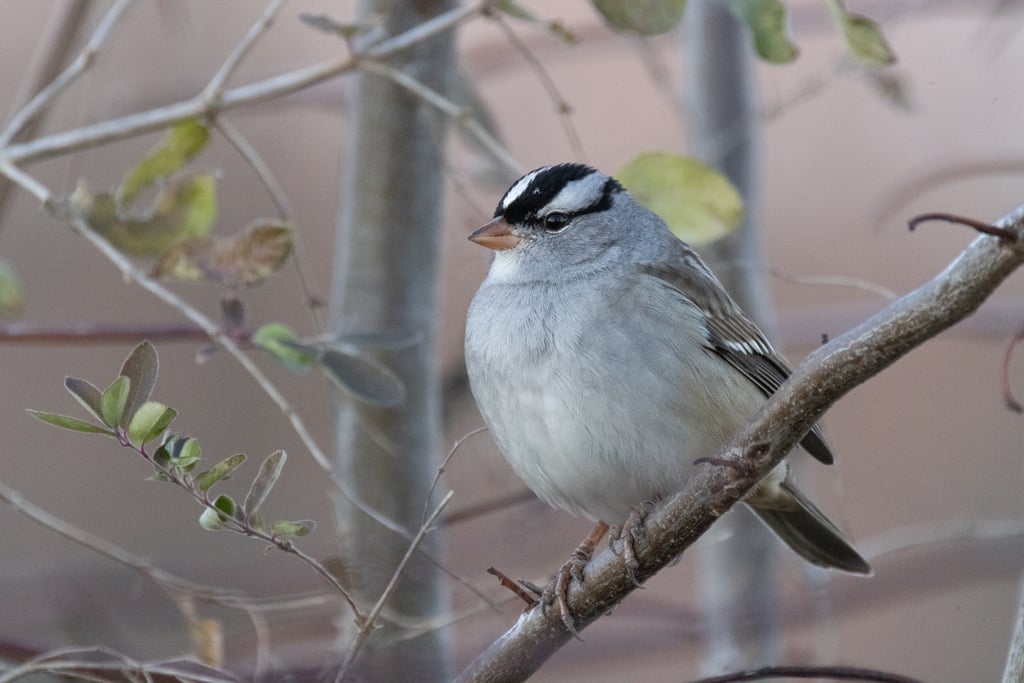
The adult crown has bold black-and-white bands, above a gray face and mostly plain gray breast. The bill is pale. Young birds have brown-and-tan crown stripes, so the adult head pattern does not cover all ages. Look at the throat and lores when separating it from a white-throated sparrow rather than relying on any striped crown.
Lookalikes: White-throated sparrows show a more distinct white throat and yellow lores. Immature white-crowned sparrows can be less straightforward.
Where to look: Brushy fields, thickets and weedy edges. Seasonal occurrence: Mostly migration and winter.
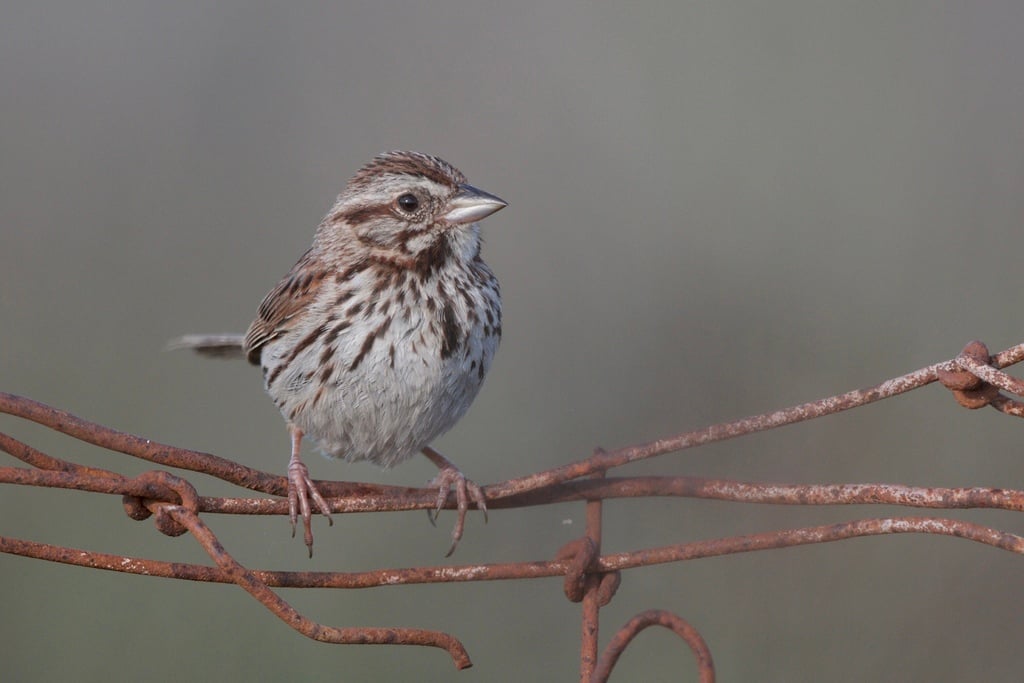
Heavy breast streaks often join in a central blotch
Brown head stripes and a relatively long, rounded tail
A song sparrow usually shows strong streaks across the breast, often meeting in a central dark spot. Brown stripes run through the face, and the tail is relatively long and rounded. Plumage varies geographically, and the central spot may be weak or hidden. Compare the streak distribution and face pattern together rather than calling every spotted sparrow a song sparrow.
Lookalikes: Savannah and Lincoln's sparrows also have streaked breasts. Fine buff-colored chest bands or different face and tail patterns call for a wider guide.
Where to look: Brushy edges, gardens and wetland margins. Seasonal occurrence: Year-round in much of Mid-Atlantic.
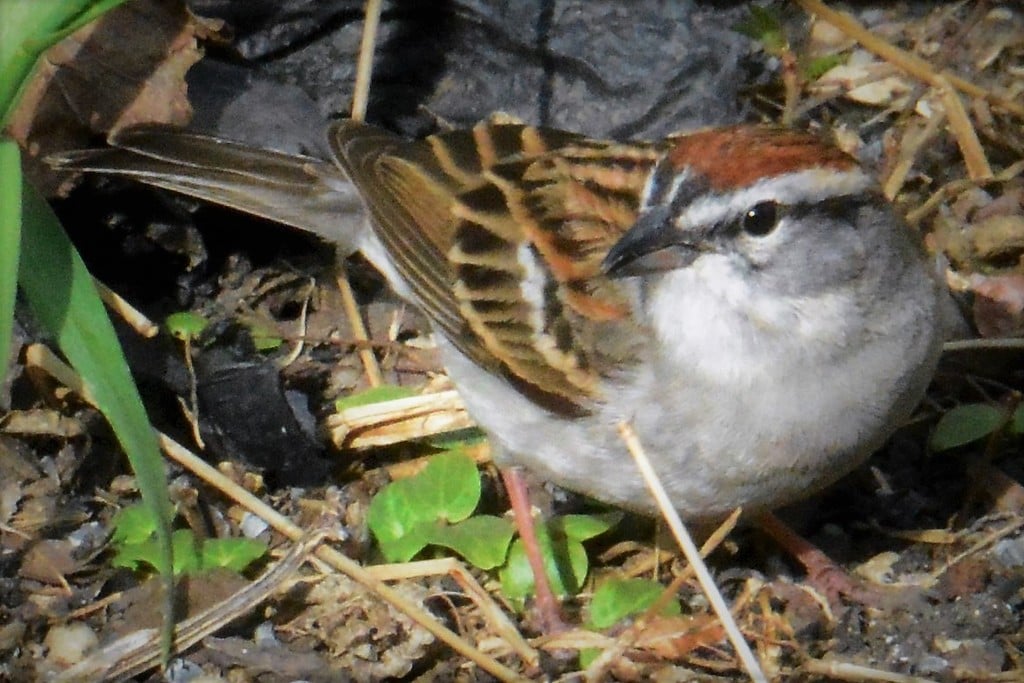
Dark line passes through the eye; plain gray breast
In breeding plumage, the rusty cap and dark line through the eye stand out against a pale face. The breast is plain gray, unlike a song sparrow's streaked chest. Nonbreeding adults have duller, more streaked crowns, and juveniles can have streaked breasts. Check season and age before applying the clean adult pattern.
Lookalikes: American tree sparrows also have rusty caps, but usually show a breast spot and a two-colored bill. A rusty cap alone does not settle the identification.
Where to look: Open woods, lawns and scattered trees. Seasonal occurrence: Mainly spring through fall.
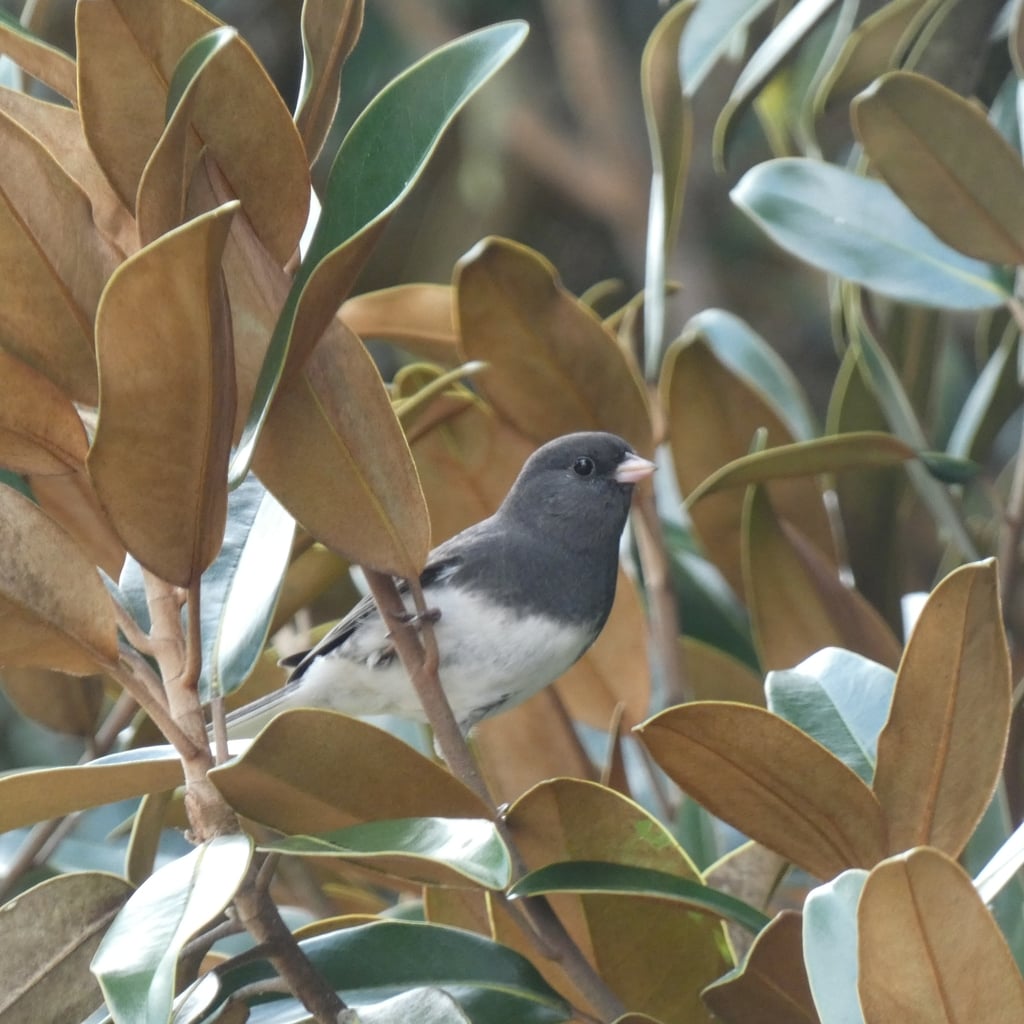
The familiar eastern slate-colored junco has a gray hood and breast above a white belly, with a pale bill. White outer tail feathers can flash as it flies away. Females may look browner, and other North American forms have different color patterns. A junco is a member of the New World sparrow family despite its less striped appearance.
Lookalikes: Do not apply the slate-colored pattern to every western junco form. A tail flash alone is shared by other birds.
Where to look: Ground beneath shrubs, woods and winter feeders. Seasonal occurrence: Fall through spring; some breed in uplands.
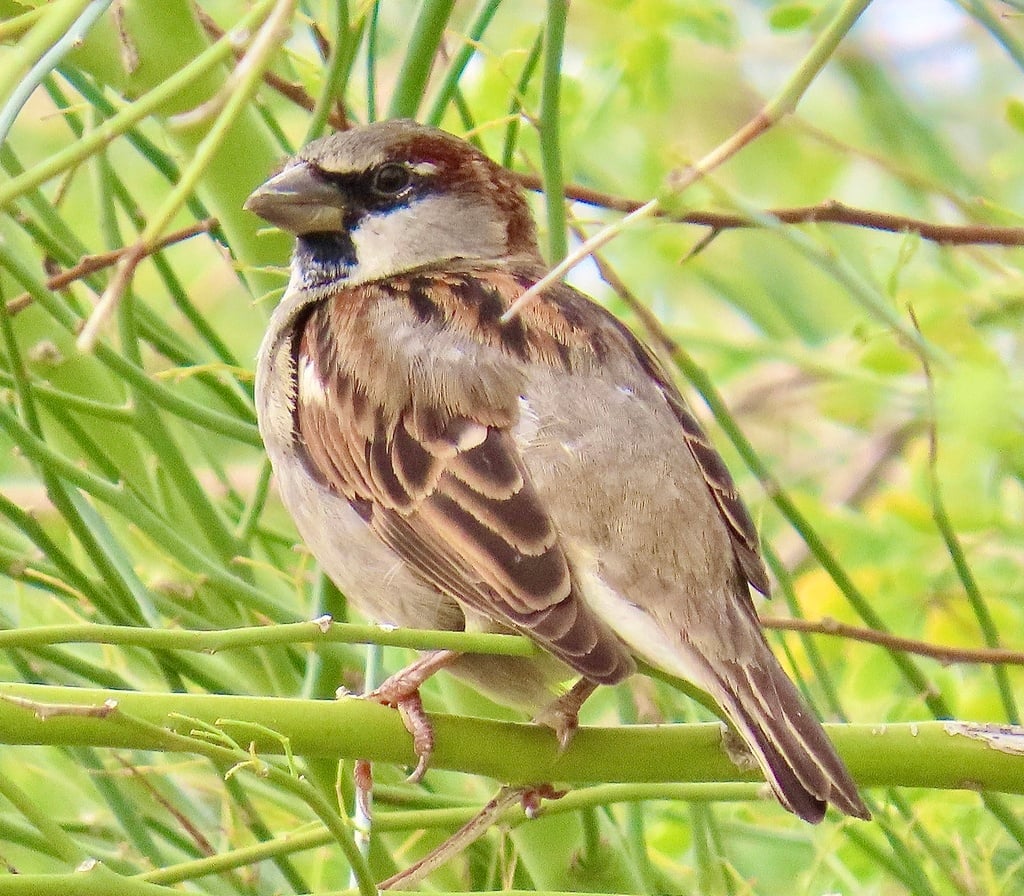
Adult male has a gray crown and chestnut behind the eye
Black throat patch varies in prominence
An adult male house sparrow combines a gray crown, chestnut on the head sides and a black throat patch. Females are brown with a pale eyebrow and plain underparts, without the male's black bib. House sparrows are introduced in North America and belong to the Old World sparrow family. Check the whole face pattern rather than assuming all feeder sparrows are this species.
Lookalikes: Female house finches have stronger breast streaking and a different bill and head pattern. A brown bird beside a male house sparrow still needs its own identification.
Where to look: Buildings, farms, towns and feeder areas. Seasonal occurrence: Year-round.
Song sparrows often have breast streaks that gather into a dark central spot. American tree sparrows can have a spot on an otherwise plainer chest. The streaking around the spot and the face pattern are more useful than the presence of the spot by itself.
What is the difference between white-throated and white-crowned sparrows?
Check the throat and the area between the bill and eye. White-throated sparrows show a distinct white throat and yellow lores. Adult white-crowned sparrows have a bold crown and a mostly gray face and throat. Young birds make this comparison less obvious.
Can a chipping sparrow have a streaked breast?
Yes. Young chipping sparrows can have breast streaking, while breeding adults usually look plain gray below. The rusty cap is also less obvious outside breeding plumage. Use a guide showing the correct age and season.
How do you photograph a small brown bird?
Try for a side view with the bill, eyebrow and tail visible, then a front view of the chest. Record the season and habitat. Avoid relying on a single cropped face or a bird viewed only from behind.