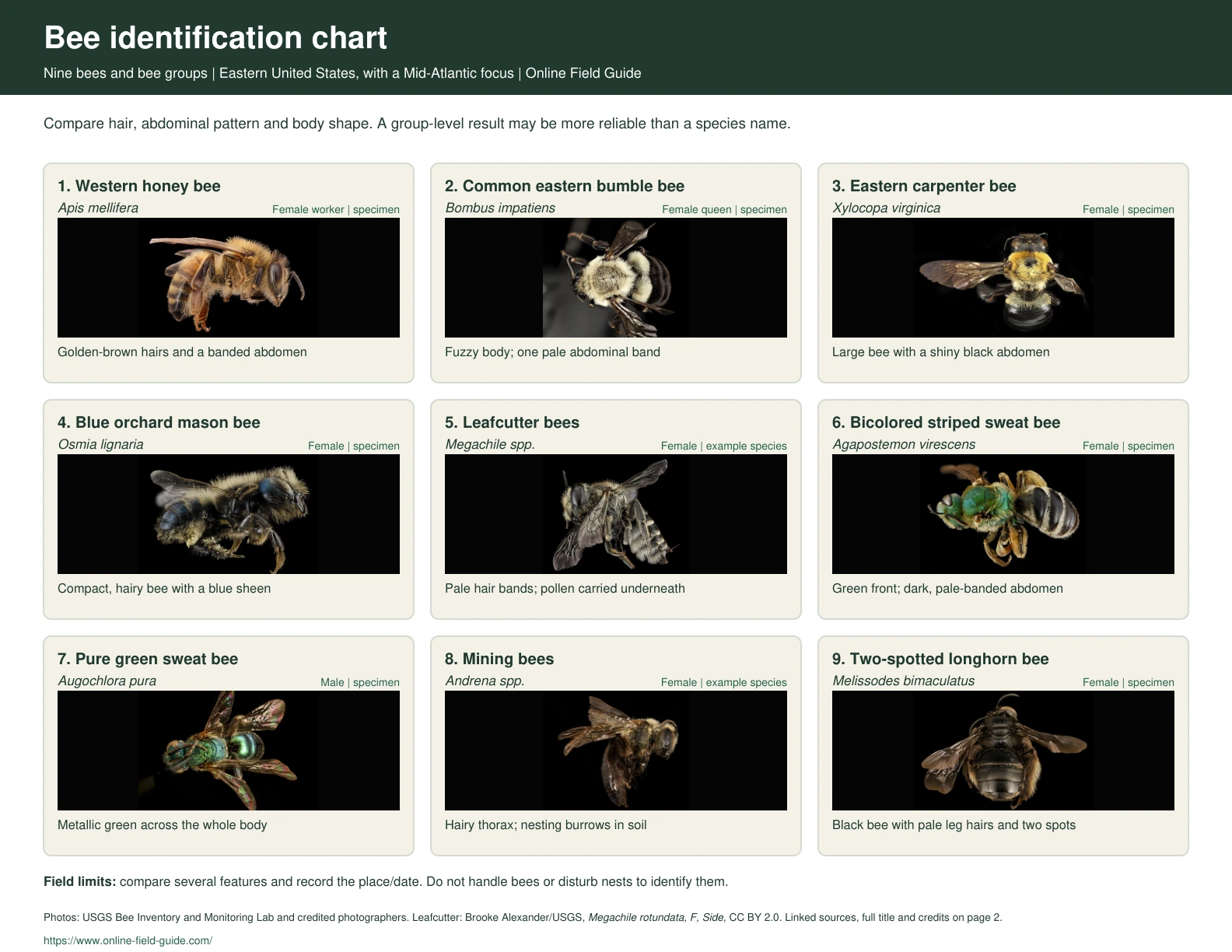
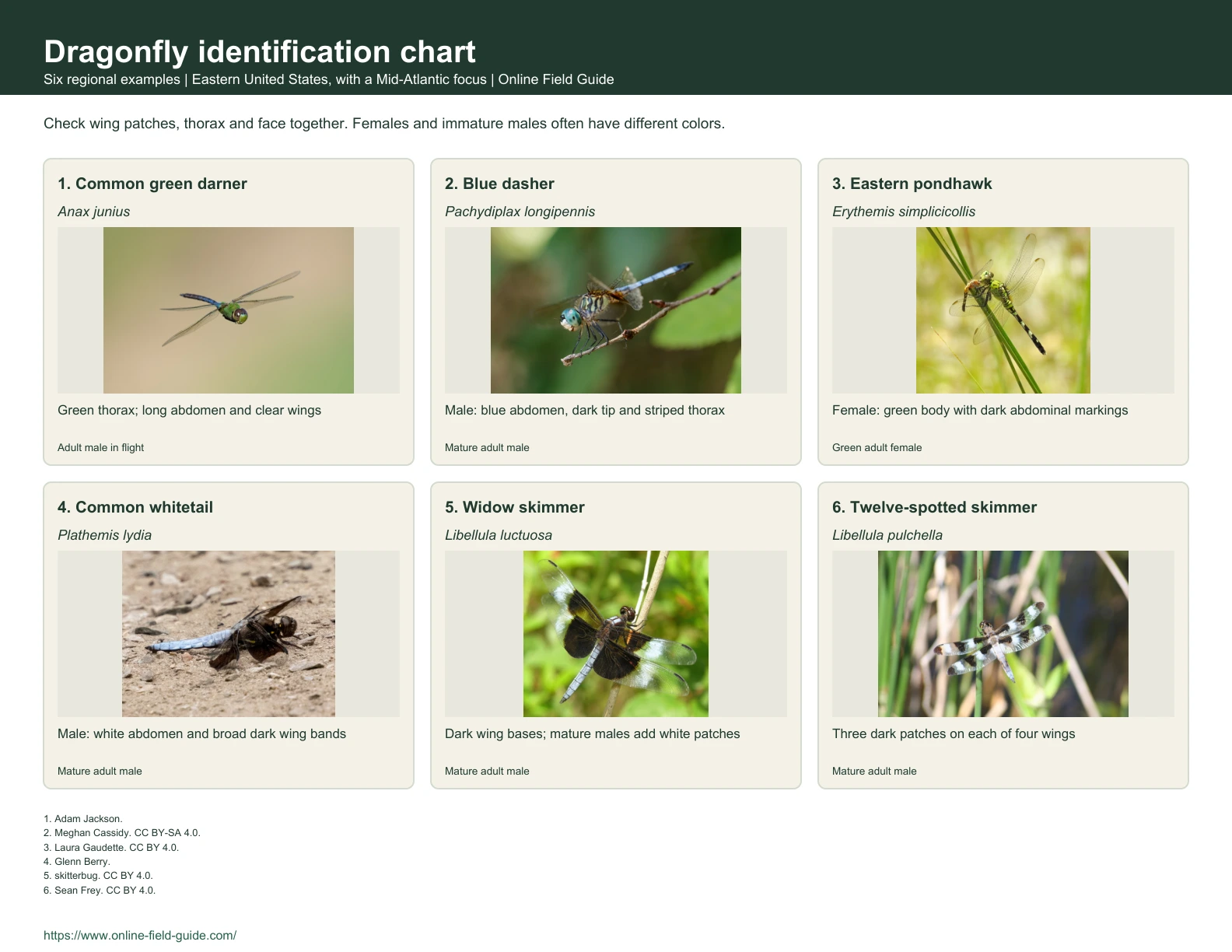
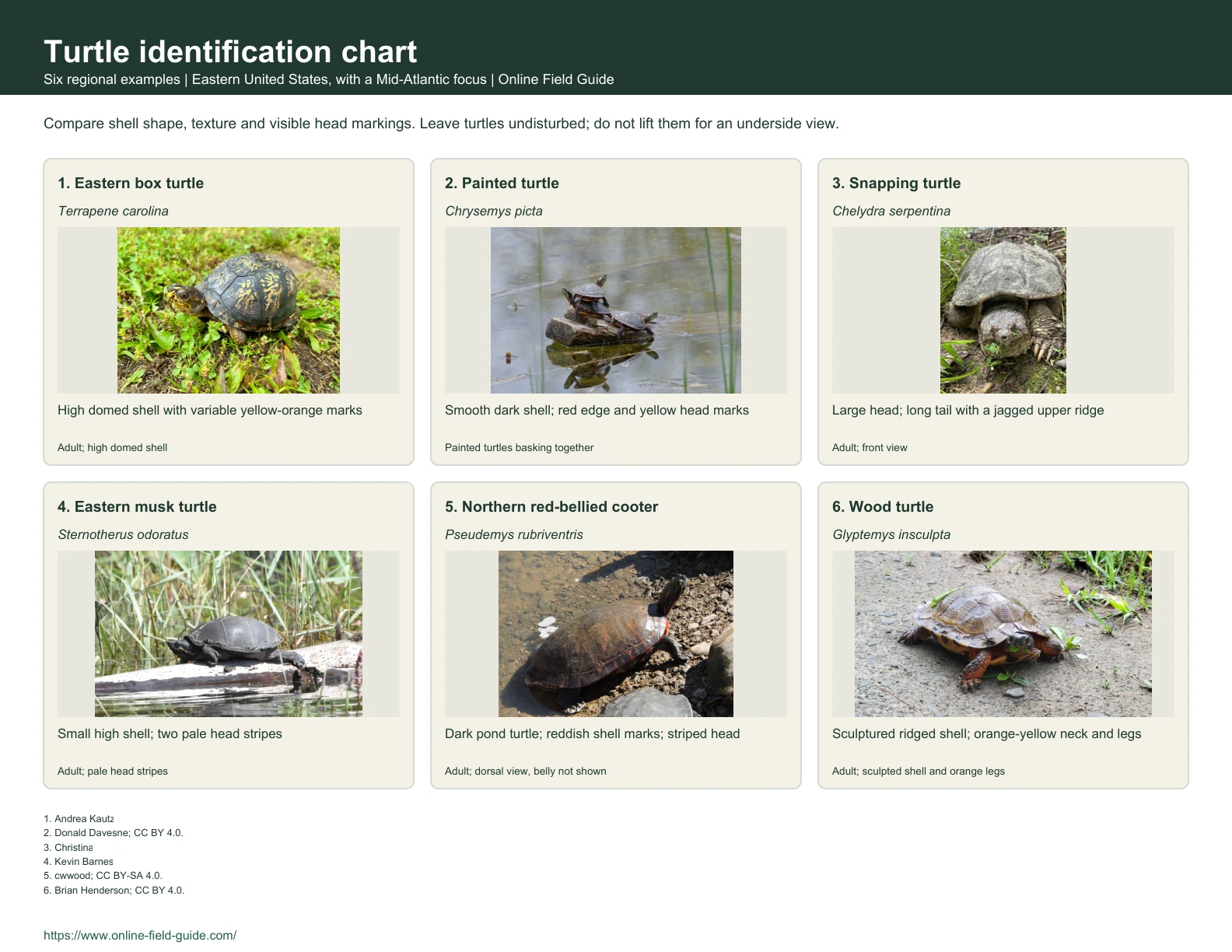
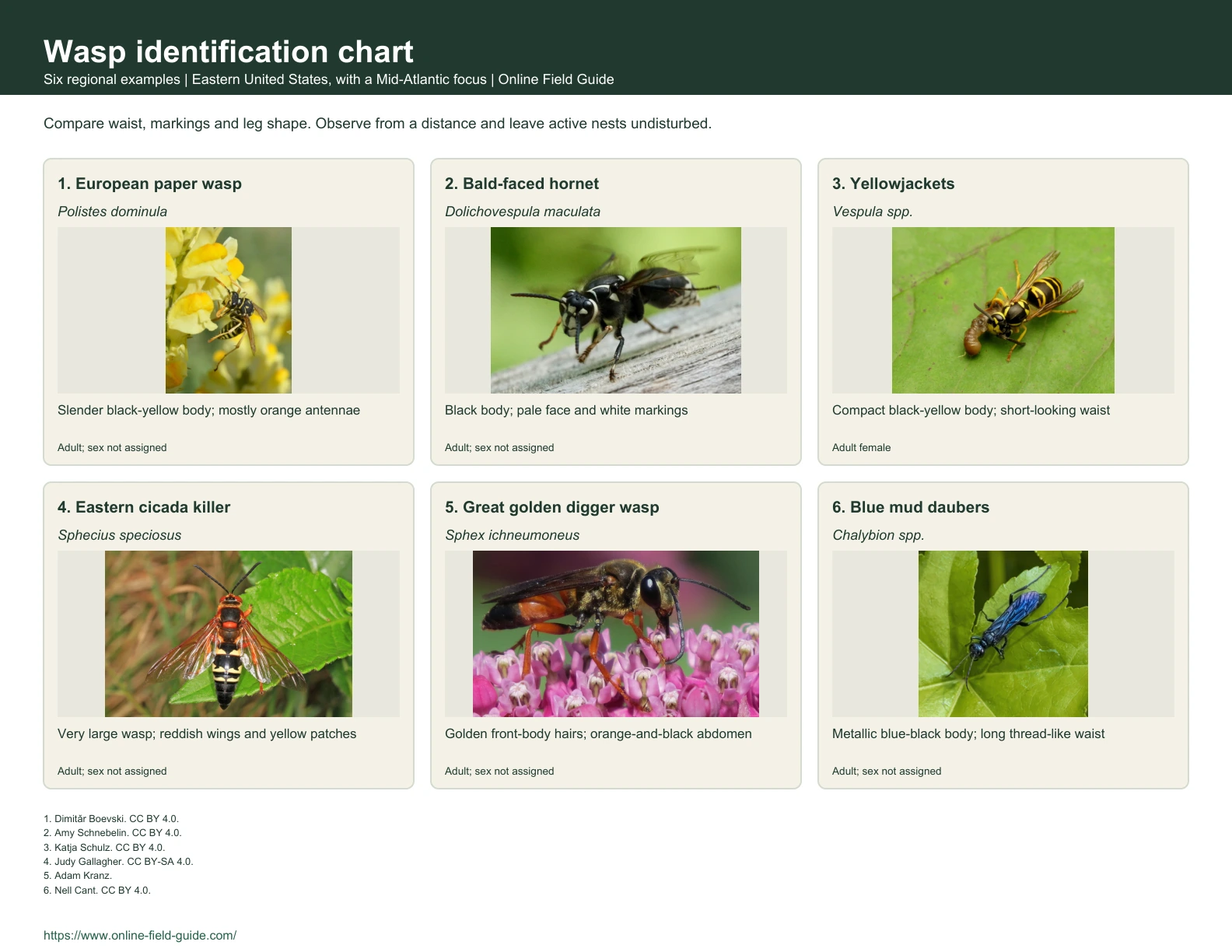
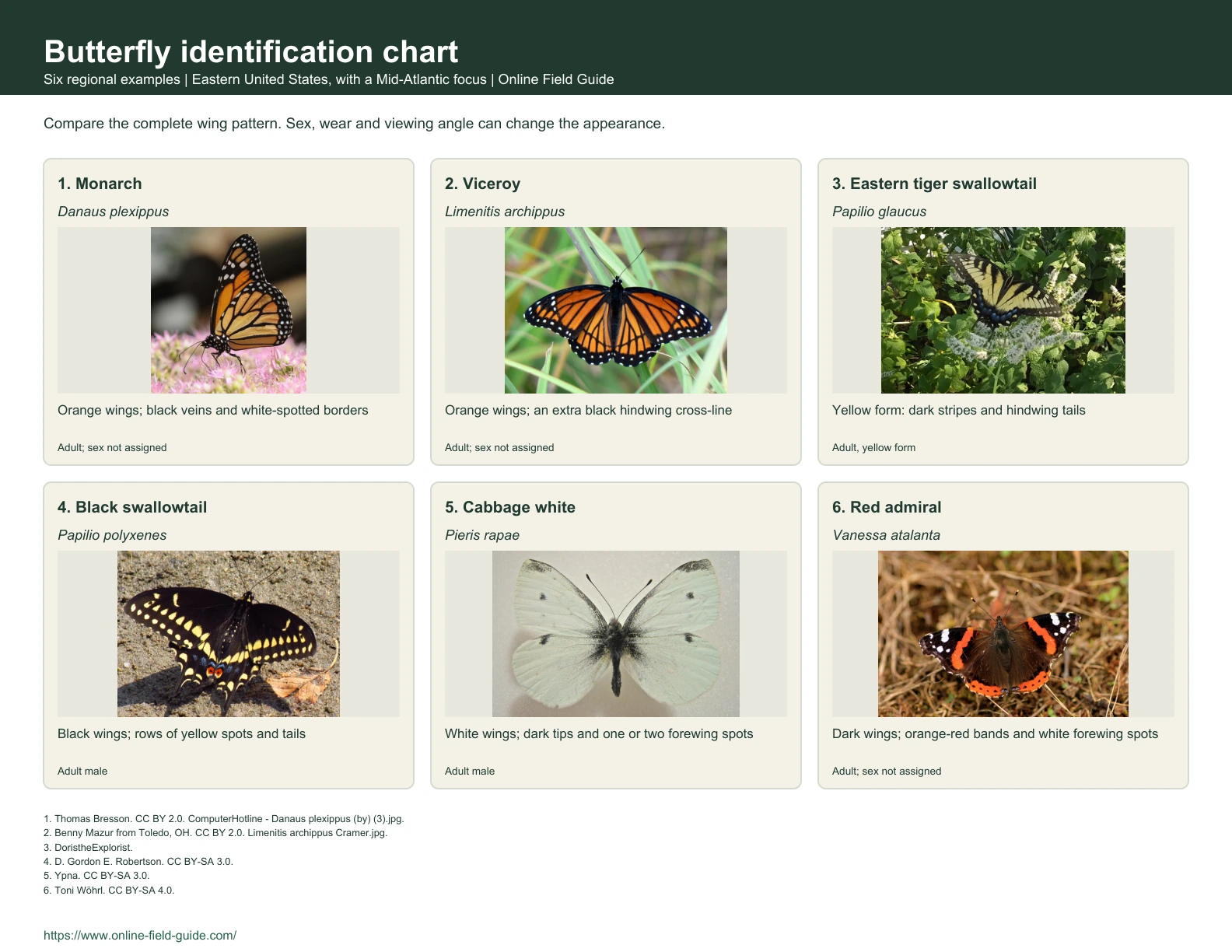
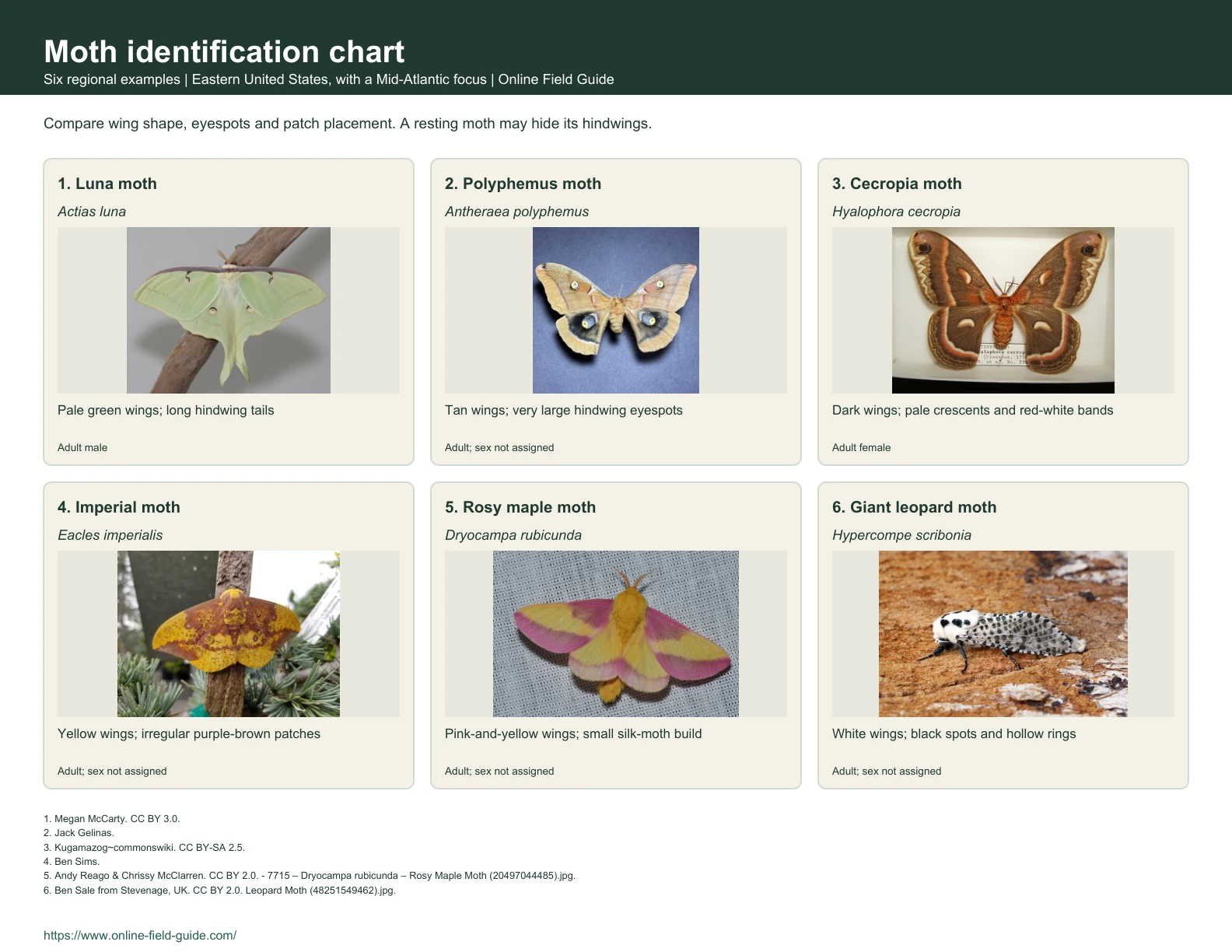
Identify an eastern-US frog by comparing its back ridges, face markings, toe pads and spot pattern. Ridges continuing down the back help separate a green frog from a bullfrog. A dark mask suggests a wood frog; mottled skin and enlarged toe pads suggest a treefrog.
These six examples occur in the eastern United States, including the Mid-Atlantic. The chart includes an American toad and a gray treefrog species complex. It compares adults, not tadpoles or eggs, and does not distinguish every closely related frog from a photograph.
Frog photo identification chart
Frog identification at a glance
Seasonal activity is a broad regional clue rather than an exact calling calendar. Frogs may remain hidden even during active months, and breeding seasons differ among species. On a small screen, scroll the table sideways.
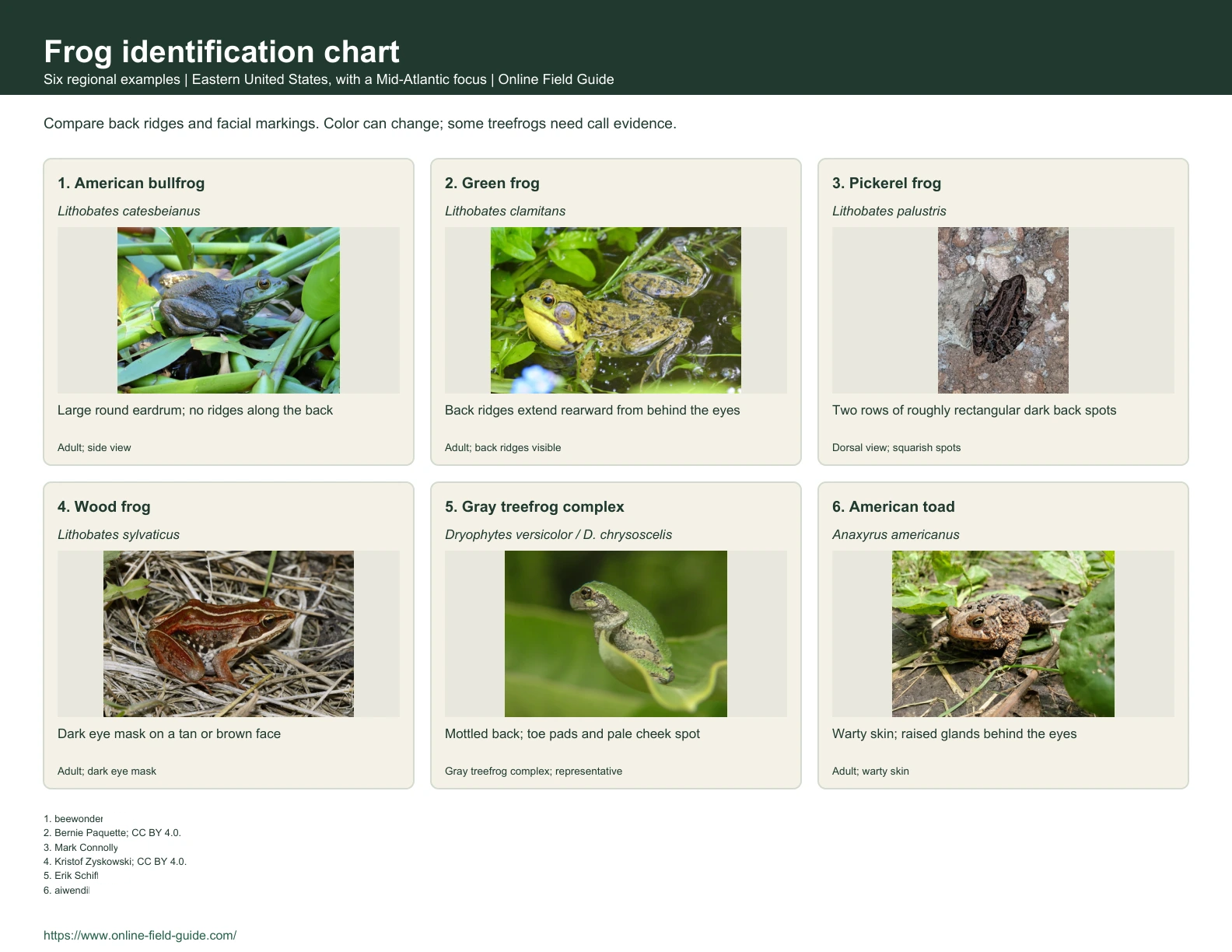
| Frog or group | First visual clue | Habitat clue | Seasonal occurrence | Identification level |
|---|---|---|---|---|
| American bullfrog Lithobates catesbeianus | Large round eardrum; no ridges along the back | Permanent ponds, lakes and slow-water edges | Spring through fall | Species candidate |
| Green frog Lithobates clamitans | Back ridges extend rearward from behind the eyes | Ponds, streams, marshes and water gardens | Spring through fall | Species candidate |
| Pickerel frog Lithobates palustris | Two rows of roughly rectangular dark back spots | Cool streams, wet meadows and woodland wetlands | Spring through fall | Species candidate |
| Wood frog Lithobates sylvaticus | Dark eye mask on a tan or brown face | Moist woods and seasonal woodland pools | Early spring breeding; active into fall | Species candidate |
| Gray treefrog complex Dryophytes versicolor / D. chrysoscelis | Mottled back; toe pads and pale cheek spot | Trees, woodland edges and nearby breeding ponds | Spring through fall; warm-season calling | Species complex |
| American toad Anaxyrus americanus | Warty skin; raised glands behind the eyes | Woods, gardens and fields near breeding water | Spring through fall | Species candidate |
Photo cards: six frogs and toads
Open a photograph for a larger view. Read the photo label before comparing the markings.
Species candidate
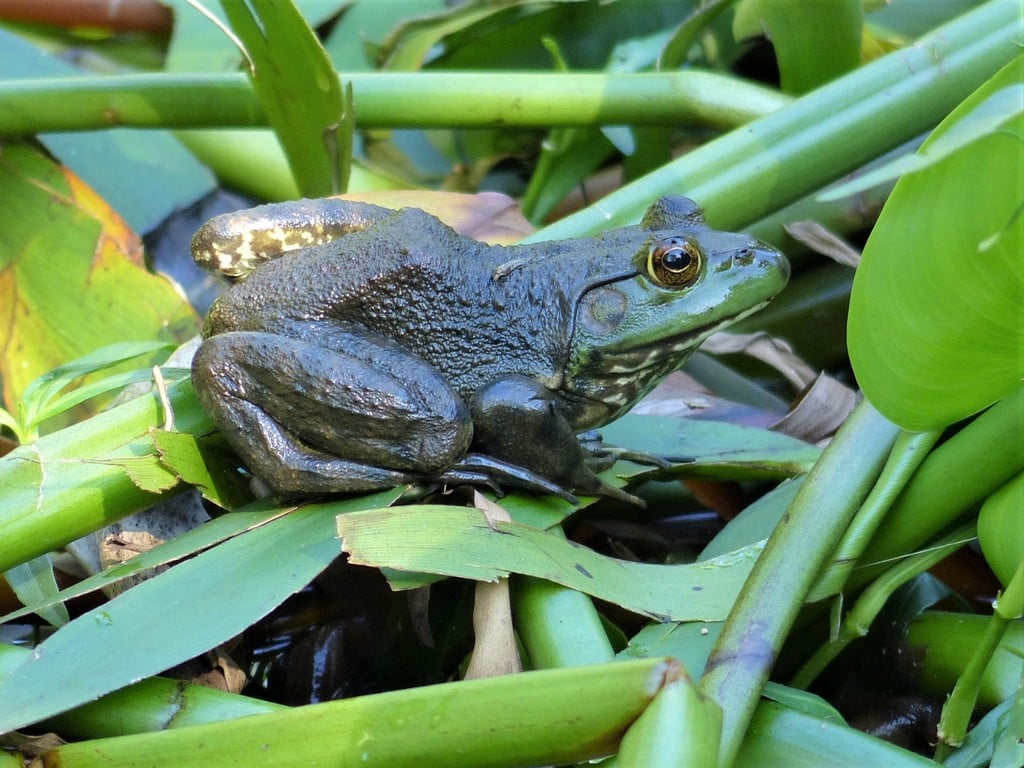
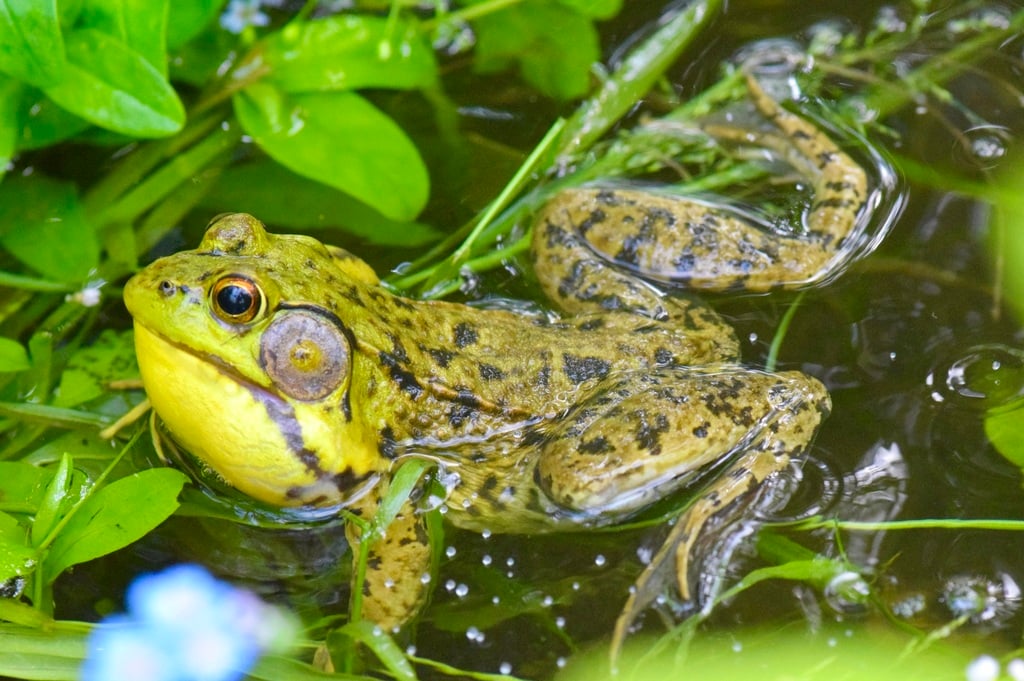
1. American bullfrog
Lithobates catesbeianus
- Ridge curves behind the eardrum rather than down the back
- Green, olive or brown body; large external eardrum
Look behind the eye for the large round eardrum, then follow the nearby skin fold. A bullfrog lacks the pair of ridges running along the back that a green frog has. Its color can be green, olive or brown, so green skin does not separate the two. Body size helps with large adults but is less useful when comparing a young bullfrog.
Lookalikes: Green frogs have distinct back ridges. A low-angle photograph may hide those ridges, so absence from a poor image is not proof.
Where to look: Permanent ponds, lakes and slow-water edges. Seasonal occurrence: Spring through fall.
Species candidate
2. Green frog
Lithobates clamitans
- Distinct skin folds run along the sides of the back
- Green face may contrast with a browner body
The paired back ridges are more useful than the name or overall color. They run rearward from near the eyes, whereas a bullfrog's fold curves around the eardrum. Green frogs can be partly brown and may have scattered dark marks. The visible eardrum can be large, especially on males, so its size alone should not decide between green frog and bullfrog.
Lookalikes: Bullfrogs lack these dorsolateral ridges. Spotted leopard frogs need comparison of the back pattern as well.
Where to look: Ponds, streams, marshes and water gardens. Seasonal occurrence: Spring through fall.
Species candidate
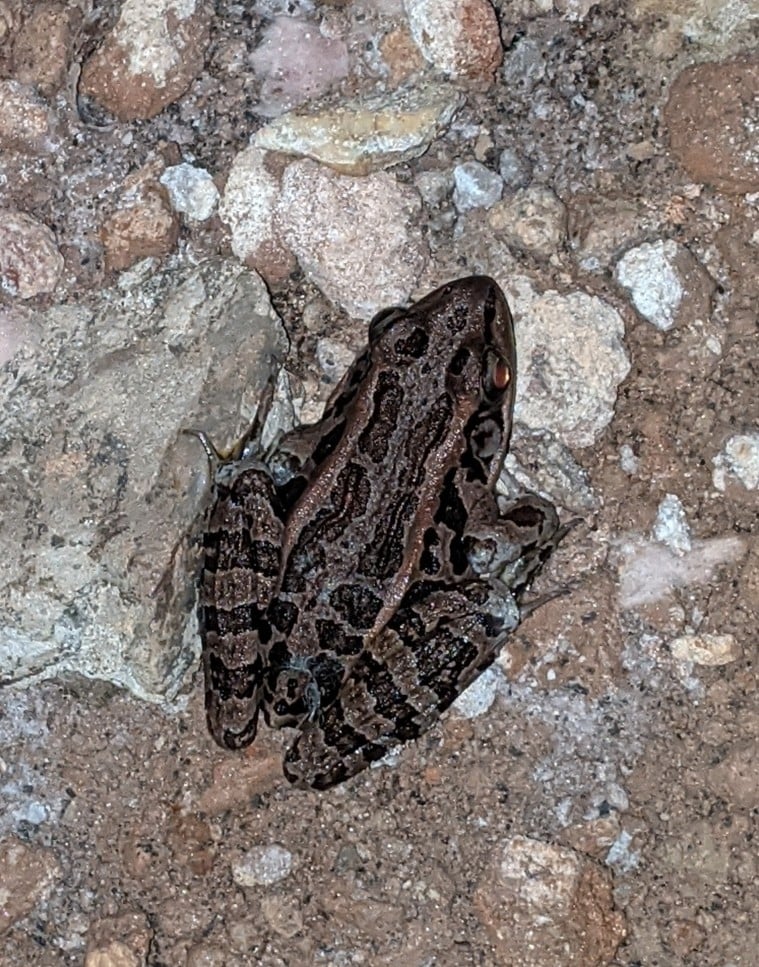
3. Pickerel frog
Lithobates palustris
- Dark, often squarish spots between pale back ridges
- Pale upper-lip line; barred hind legs
A pickerel frog usually has two rows of dark, roughly rectangular spots between the ridges along its back. The background is often tan or brown, and a pale line runs along the upper lip. Yellow-orange on the concealed surfaces of the hind legs can support identification when shown naturally. Do not turn a frog over or pull out its legs to look for it.
Lookalikes: Leopard frogs often have rounder spots. Spot shape can be irregular; compare the full pattern and a regional guide.
Where to look: Cool streams, wet meadows and woodland wetlands. Seasonal occurrence: Spring through fall.
Species candidate
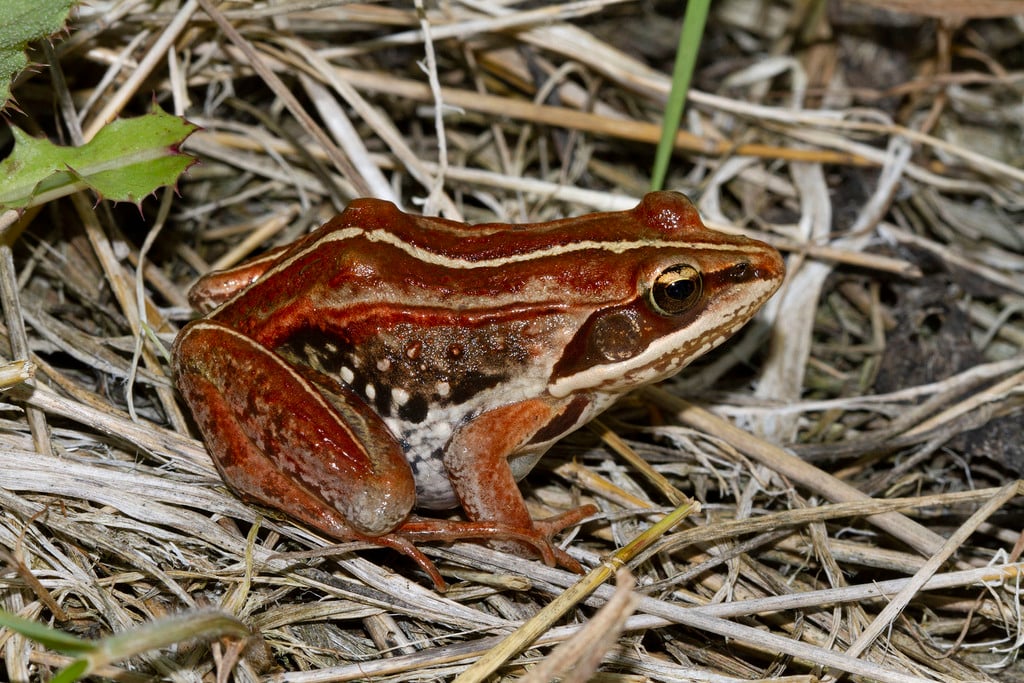
4. Wood frog
Lithobates sylvaticus
- Dark patch runs from the snout through the eye
- Back ridges and often a pale upper-lip line
The dark face mask is a good starting clue. A wood frog often has a tan, brown or reddish back, paired back ridges and a pale line along the upper lip. It spends much of its time in woodland rather than on an open pond edge. Adults gather at temporary pools early in spring, then become much harder to notice in leaf litter.
Lookalikes: A face shadow is not the same as a real mask. Compare a well-lit side view with the back and habitat.
Where to look: Moist woods and seasonal woodland pools. Seasonal occurrence: Early spring breeding; active into fall.
Species complex
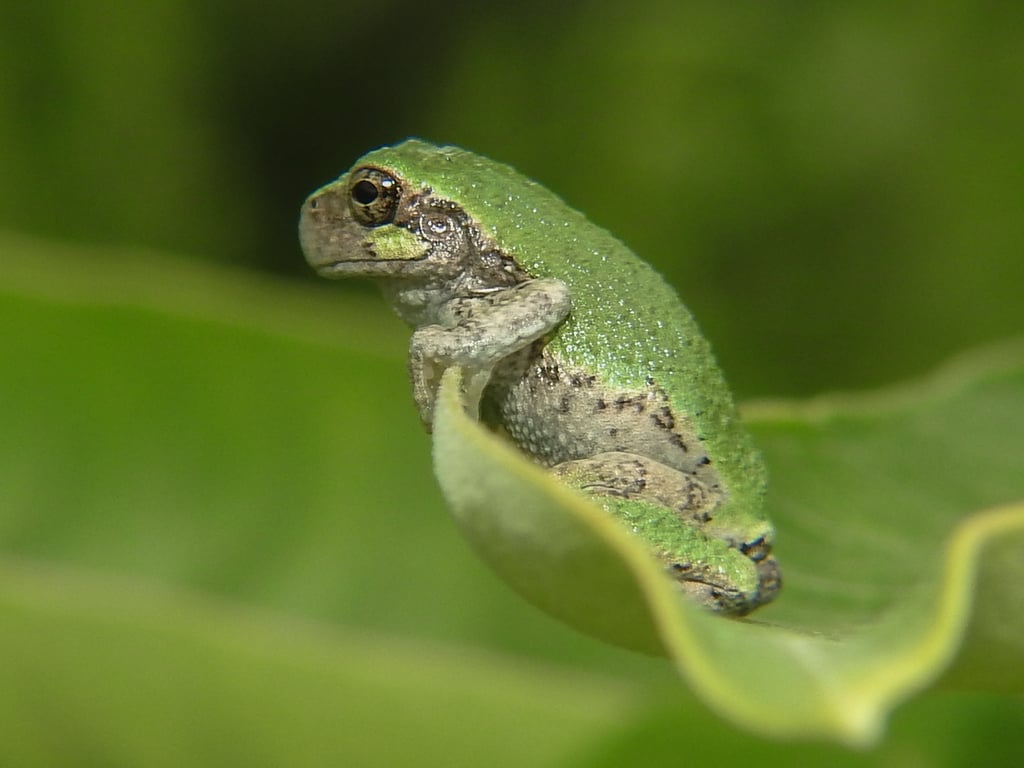
5. Gray treefrog complex
Pictured: Dryophytes versicolor
- Enlarged adhesive pads at the toe tips
- Pale spot below the eye; skin may be gray or green
Gray treefrogs can be gray, brown or green, often with irregular darker blotches. Enlarged toe pads and the pale spot below the eye are useful. Gray treefrog and Cope's gray treefrog are so similar that this chart treats them together. Calls, interpreted with temperature and regional range, can help specialists separate the species. A source-labelled photograph does not make the visible pattern a species-level key.
Lookalikes: Cope's gray treefrog cannot reliably be excluded by this photo. Green treefrogs have a different body pattern, often including a light side stripe.
Where to look: Trees, woodland edges and nearby breeding ponds. Seasonal occurrence: Spring through fall; warm-season calling.
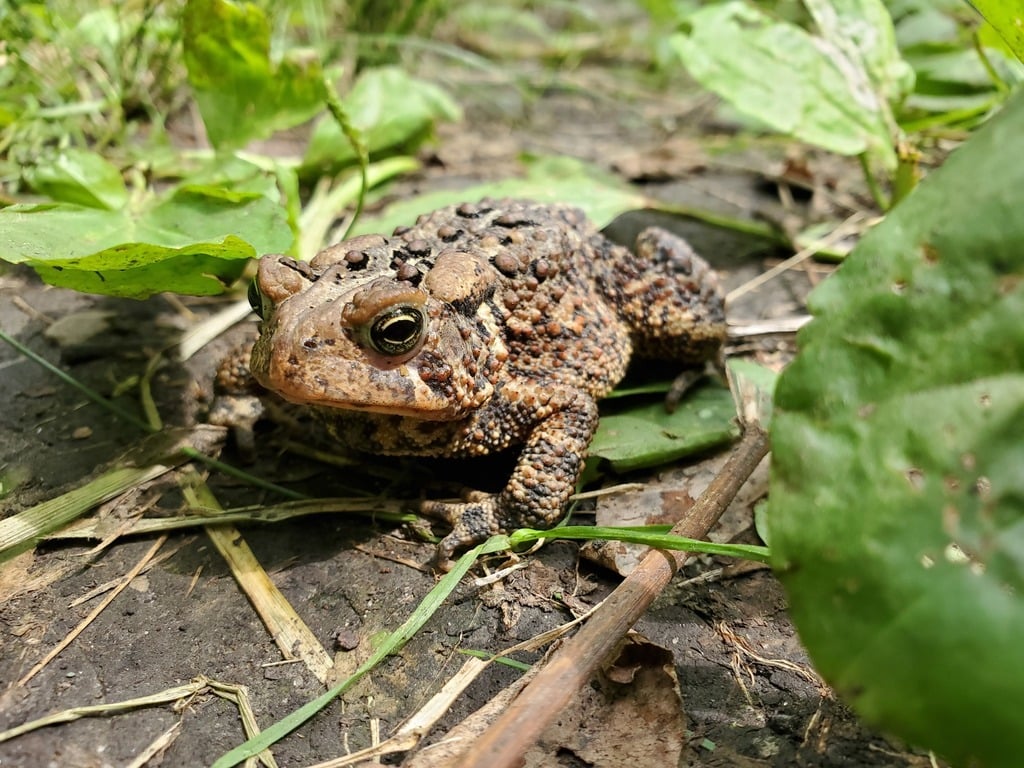
Species candidate
6. American toad
Anaxyrus americanus
- Stocky body with conspicuous skin bumps
- Many dark back spots contain one or two larger warts
An American toad has a stocky build, warty skin and raised parotoid glands behind the eyes. Many dark back spots contain one or two larger warts, although markings vary. It commonly walks or makes short hops on land away from its breeding pond. Skin texture separates it from the smooth-bodied frogs here, but it does not distinguish every regional toad species.
Lookalikes: Fowler's toads can resemble it and often have more small warts per spot. Hybrids and variable markings require several traits, not a wart count alone.
Where to look: Woods, gardens and fields near breeding water. Seasonal occurrence: Spring through fall.
Bullfrog or green frog: which feature matters most?
Look for ridges running down the sides of the back. Green frogs have them; bullfrogs do not. A bullfrog instead has a fold curving around the eardrum. Compare a clear view of the back rather than relying on size or green color.
Can a gray treefrog be bright green?
Yes. Gray treefrogs can change color and may look green, brown or gray. Toe pads, the cheek spot and overall pattern are more useful than the color alone. Gray and Cope's gray treefrogs are treated as a complex here because photographs often cannot separate them.
Does this chart identify tadpoles or frog eggs?
No. Tadpoles and egg masses need a separate guide, and their appearance changes as they develop. An adult frog near a pond does not prove that every tadpole in it belongs to that species.
How can you record a frog without handling it?
Take a side view and a view of the back from where you stand, and record the place, date and habitat. If the frog calls, a short recording may help. Do not catch it, pull out its legs or move it between ponds; use the features it shows naturally.
For more regional detail, see the Maryland DNR frog and toad accounts.
Related reading: Frogs, toads and other amphibians.