
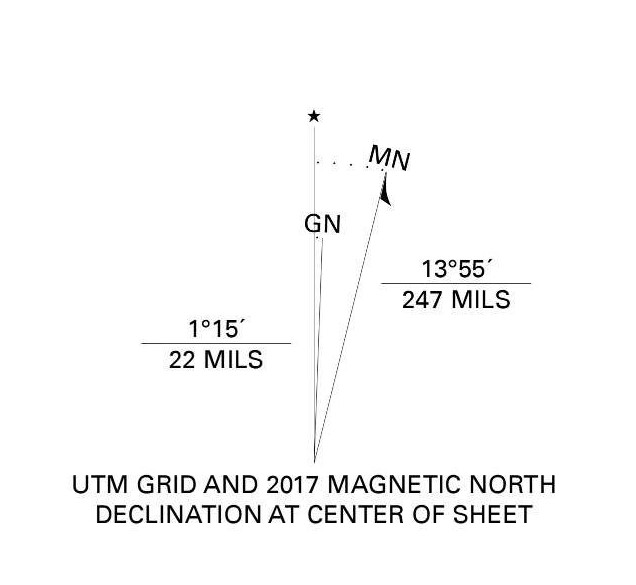
True north points toward the geographic North Pole. Magnetic north is the direction the north-seeking end of a compass needle points where you stand. The angle between the two directions is called magnetic declination.
If you take a bearing from a map and use that number on an ordinary compass, you may head off at an angle to the route you drew. Check which kind of north the map uses, then look up the current declination for your location.
Why the Compass and Map Can Disagree
A compass responds to Earth’s magnetic field where you stand. The magnetic field varies across the world and changes over time. A declination value from one city, or from an old map, may be wrong for today’s route. Look up the location and date in the NOAA magnetic field calculators.
An east declination means the magnetic north direction is east of true north. A west declination means it is west. At a location with zero declination, the two directions coincide.
How to Convert a Magnetic Bearing to True
For an uncorrected magnetic bearing, add the signed declination to get a true bearing. Treat east as positive and west as negative. With a magnetic reading of 70° and an east declination of 12°, the true bearing is 82°. With 12° west declination, it would be 58°.
When starting from a true bearing, reverse the calculation. If your map route is 82° true and local declination is 12° east, the equivalent magnetic bearing is 70°. Wrap results below 0° or at or above 360° back into the circle. Check whether your compass or navigation app already applies a correction before doing it by hand.
Where Grid North Fits
The USGS diagram above uses a star for true north, GN for grid north, and MN for magnetic north. Its declination is dated 2017. For a bearing today, check current values for the location. True north follows the geographic meridian. Grid north follows the map’s north-south grid lines. Magnetic north follows the compass direction. If you measure your route against a grid line, you have a grid bearing. Use the map’s north diagram to check the angle between grid and true north before using the true-to-magnetic conversion above. Some maps also give the grid-to-magnetic angle directly.
That extra angle can matter if you are trying to reach a specific point across open ground. A direction error of 10° can put you about 174 meters to the side of your planned line after walking one kilometer. Before setting out, identify which north reference your map, compass and app each use.
Featured diagram: U.S. Geological Survey